
Turning Evidence into Impact
Monitoring, evaluation and learning are an important part of our partnership with you.
Together, we want to understand not only what activities are taking place, but also what difference they are making for children, young people, families and communities. This does not mean collecting data simply for the sake of reporting. The information we gather should help us understand progress, recognise challenges, improve programmes and demonstrate the impact of the work being done. We work with our partners throughout this process, from collecting and interpreting information to reflecting on results and sharing the stories behind the numbers.
Good evidence helps us learn, improve and tell a stronger story about the change we are creating together.
How We Work Together
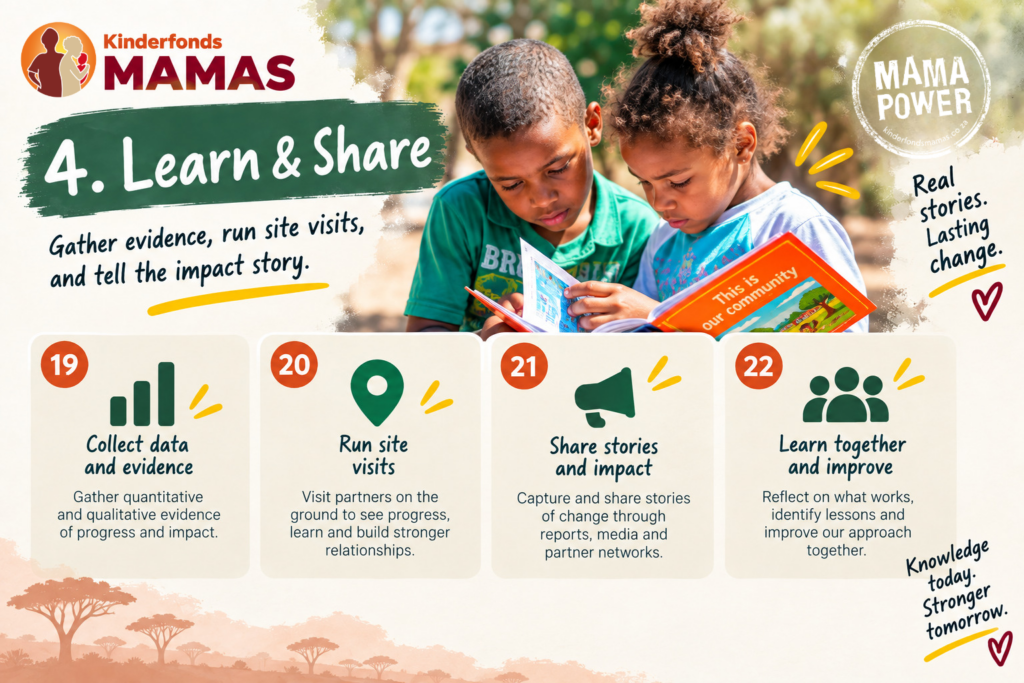
- Collect Data and Evidence
Partners collect information that helps us understand programme activities, participation, progress and outcomes. Depending on the programme, this may include quantitative information such as participant numbers and programme results, as well as qualitative information such as observations, feedback and stories of change.We work with partners to make sure that the information being collected is useful, realistic and connected to what the programme is trying to achieve. - Monitor Progress
Monitoring helps us see whether programmes are being implemented as planned and whether they are moving towards their intended outcomes.
Regular reporting and communication allow us to identify progress, challenges and areas where additional support may be needed. The purpose is not simply to check whether targets have been reached. It is also to understand why things are working, where difficulties are emerging and what we can learn from them. - Site Visits and Learning on the Ground
Site visits give us an opportunity to see programmes in practice and understand the context in which our partners are working. They allow us to speak with teams, observe activities, discuss progress and challenges, and learn directly from the people delivering the work. Site visits are also an important part of strengthening relationships between Kinderfonds MAMAS and our partners. They create space for open conversation, shared learning and practical problem-solving. - Measure Outcomes and Impact
Programme activities and participant numbers are important, but they only tell part of the story. Where possible, we also look at the changes that happen as a result of the work. These may include changes in knowledge, behaviour, wellbeing, confidence, opportunities, organisational capacity or other outcomes connected to the programme. Over time, this helps us build a clearer picture of the difference programmes are making. - Share Stories of Change
Behind every number is a person, family or community. Stories of change help us understand and communicate the human impact of programmes in a way that statistics alone cannot. Together with our partners, we capture stories that illustrate progress, challenges, learning and meaningful change. These stories may contribute to programme reports, communications, donor reporting and wider learning across the MAMAS Alliance.
Where stories or images involve children or programme participants, they should always be collected and shared responsibly and in line with safeguarding, consent and privacy requirements. - Learn Together and Improve
Monitoring and evaluation are most valuable when the information leads to learning. We encourage partners to reflect on their results, ask questions and identify what can be improved. Sometimes the evidence confirms that an approach is working well. At other times, it may show that something needs to change. Both are valuable.
By sharing experiences and lessons across the MAMAS Alliance, organisations can learn from one another and strengthen their programmes over time.
What We Ask From Our Partners
Effective monitoring and learning is a shared responsibility.
As a Kinderfonds MAMAS partner, you may be asked to:
- Collect agreed programme information accurately and consistently
- Submit programme and monitoring reports within agreed timelines
- Keep supporting evidence where required
- Participate in site visits and programme reviews
- Share challenges as well as successes
- Help identify useful lessons from programme implementation
- Collect stories of change and participant feedback where appropriate
- Protect the privacy, dignity and safety of programme participants when collecting or sharing information
The exact monitoring and reporting requirements will depend on your organisation, programme and funding agreement.
How Kinderfonds MAMAS Supports You
You are not expected to do this alone.
Kinderfonds MAMAS works alongside partners to help strengthen monitoring, evaluation and learning practices. Depending on the programme and the needs of your organisation, this may include support with defining indicators, collecting information, understanding results, reporting and reflecting on what the evidence is telling us.
Where challenges arise, we want monitoring to help us identify them early and work through them together, rather than simply record them after the fact.
From Information to Learning
The purpose of all of this is not to produce more paperwork.
It is to create a simple cycle:
Collect evidence → understand what it tells us → learn from it → improve what we do → share the impact.
When partners and Kinderfonds MAMAS use evidence in this way, monitoring becomes more than a reporting requirement. It becomes a tool for stronger programmes, better decisions and greater impact.
Why It Matters
Reliable information helps us understand whether our programmes are reaching the people they are intended to reach and whether they are contributing to meaningful change. It also allows us to demonstrate accountability to communities, partners and funders while building a stronger body of learning across the MAMAS Alliance.
Most importantly, it helps us keep asking the question that matters: Are we making a meaningful difference in the lives of the children, young people and families we serve, and how can we do it better?

Brian Zaca
Monitor & Evaluation Lead
brian@mamasalliance.com